Briefings
Midterms and consumer credit: gridlock, with one exception
With Democrats now leading both houses of Congress, credit cards look like the one corner of consumer credit where new federal law is plausible. Elsewhere, expect gridlock: Democrats lack 60 Senate votes, and the president has promised vetoes. The new Congress sits January 3 (some races remain uncalled).
Two card bills, different odds
The Credit Card Competition Act (better odds). It would require issuers with over $100 billion in assets to enable a second, unaffiliated network on each card, so merchants can route to the cheaper one. It doesn't cap interchange directly. It's bipartisan (Senators Durbin and Marshall), and the president endorsed it in January, calling swipe fees an "out of control ripoff." Likely vehicle: a must-pass bill, possibly in the lame duck. Obstacles: bank and network opposition over rewards and credit access, and the January retirement of Senator Durbin, its longtime champion. CCM noted in October that the election had put the bill on the clock.
A rate cap (harder). The president called in January for a one-year, 10% cap, and Senators Sanders and Hawley introduced a 10% bill in 2025. Neither moved under a Republican Congress. A cap still needs 60 Senate votes. Supporters say it would ease costs for households carrying balances; critics say lenders would cut credit to riskier borrowers. A higher or temporary cap seems more plausible than a flat 10%.
What it would mean for card ABS
For credit card securitizations, the two bills work through the same line: portfolio yield, and the excess spread it produces after investor coupons, servicing and charge-offs.
Exhibit 1
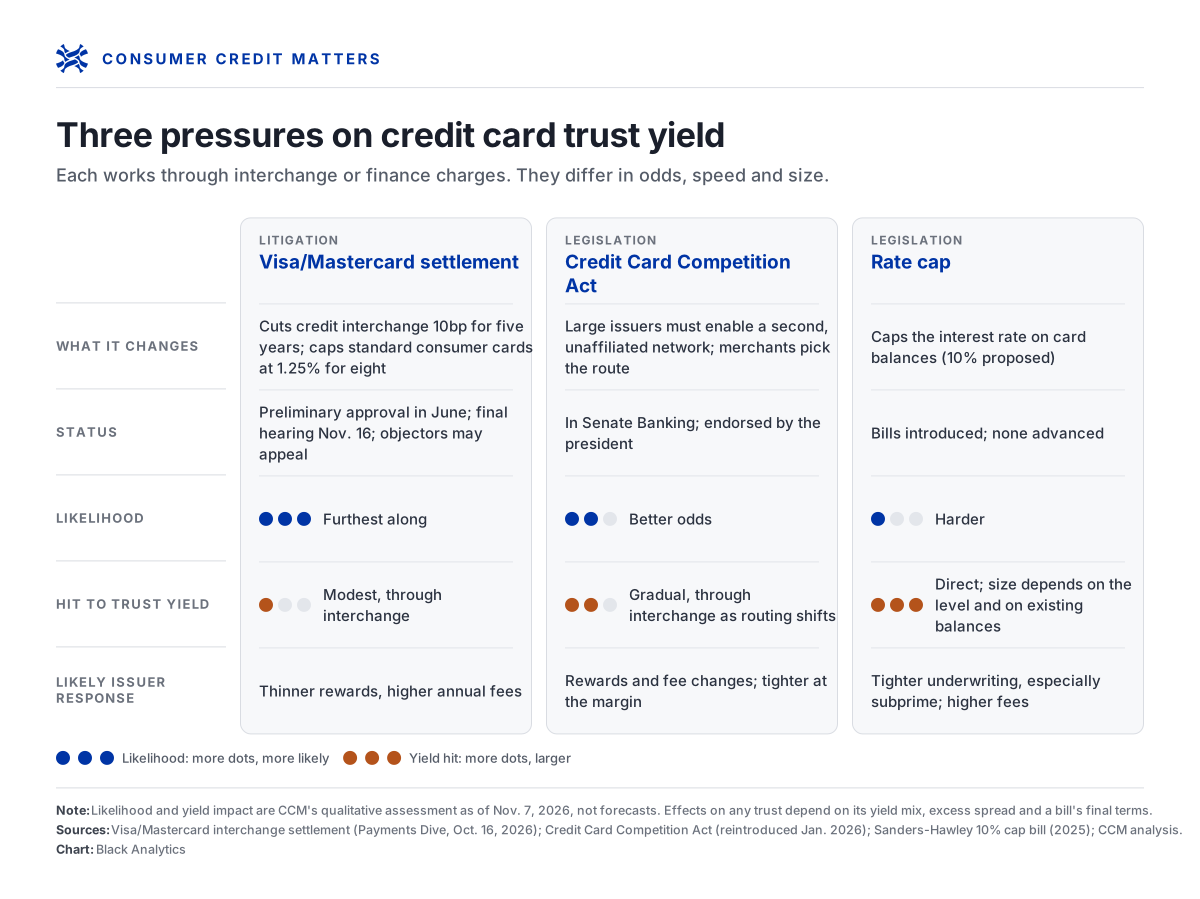
A rate cap hits yield directly. Finance charges are the largest part of trust yield. A cap well below current card rates could squeeze excess spread hard, and sustained negative excess spread is a standard early amortization trigger in master trusts. How a cap treats existing balances (grandfathered or not) would matter as much as the level.
The Credit Card Competition Act works more slowly. Many bank master trusts count interchange in their yield, and the Visa/Mastercard settlement, which would cap interchange on standard consumer cards at 1.25%, would already trim it. The settlement won preliminary approval in June, faces a final approval hearing on November 16, and merchant objectors may appeal. If merchants also route to cheaper networks, that income falls further, gradually. Cards issued on the issuer's own network, such as American Express and Discover, are exempt.
Issuers have levers. They could add or raise annual fees, cut rewards, or, in trusts that allow it, designate receivables as discount option receivables to support yield.
Underwriting would likely tighten. Issuers facing lower yields would likely pull back from subprime borrowers. That could slow receivables growth while improving the credit quality of what remains in the trusts.
The net credit effect for trusts: lower yield and thinner excess spread, partly offset by stronger collateral if underwriting tightens. A bill's terms (the level, the timing, and whether existing balances are grandfathered) will decide which dominates.
Elsewhere: oversight, not new law
Outside cards, the new Congress is more likely to hold hearings than pass laws. Federal agencies remain under the president's appointees.
CFPB. A House bill to move the bureau to annual appropriations and narrow its enforcement powers (H.R. 10184) cleared committee in September but is unlikely to advance. Expect hearings on dropped enforcement cases rather than a rebuilt bureau.
Collections, medical debt and credit reporting. The rules on the books won't change. What will is the pressure: expect hearings, letters to regulators and requests for watchdog reviews, pushing the CFPB to resume supervision and enforcement and putting companies' practices on the public record.
Crypto and stablecoins. Market-structure legislation (the CLARITY Act) stalled in the Senate in September, as CCM's preview of the vote suggested it might. Its fate, including the fight over stablecoin rewards, now rests with Democratic leaders. Implementation of the GENIUS Act, which takes effect in January, will likely draw closer scrutiny.
The states. With federal enforcement lighter, state attorneys general and legislatures have been moving on collections rules that go beyond federal minimums. That trend likely continues, and for many lenders it may matter more than Congress. Collections attorney John Bedard made this case on CCM podcast episode 24.
What to watch
November 16. The final approval hearing on the Visa/Mastercard interchange settlement.
The lame-duck session. Whether the Credit Card Competition Act's sponsors try again on a must-pass bill before January 3.
Committee leadership. Who chairs Senate Banking and House Financial Services. Senator Warren, the ranking Democrat on Senate Banking, could become chair; observers expect consumer protection, including card rates and fees, to rank high on her agenda.
Early bills. Whether a rate cap is reintroduced, at what level, and with which Republican cosponsors.
Issuer signals. Any moves on rewards, annual fees or underwriting ahead of legislation.
CCM read: Divided government usually means little new law, and most of consumer credit should expect exactly that. Credit cards are the exception worth watching, because both parties have reasons to act and the president is already on record. For card ABS investors, the question isn't whether a bill passes this year but what its terms would do to trust yield, and how much cushion today's excess spread provides.
Why Moody's rated a Treasury-backed stablecoin only A2
Last week, CCM looked at what Ripple calls Moody's first investment-grade stablecoin rating: A2/P-1 on Ripple USD (RLUSD), Ripple's $2.6 billion digital dollar (CCM, November 2). The puzzle was why a token backed mostly by Treasury bills rated only A2. Moody's new issue report now answers it: the reserve isn't what holds the rating back; the legal and operational plumbing around it is. For anyone weighing stablecoins as a cash alternative, that distinction is the story. The report is silent on the Binance hack, in which Ripple froze some RLUSD two days after the rating.
The reserve scored Aa. The structure cost the rest
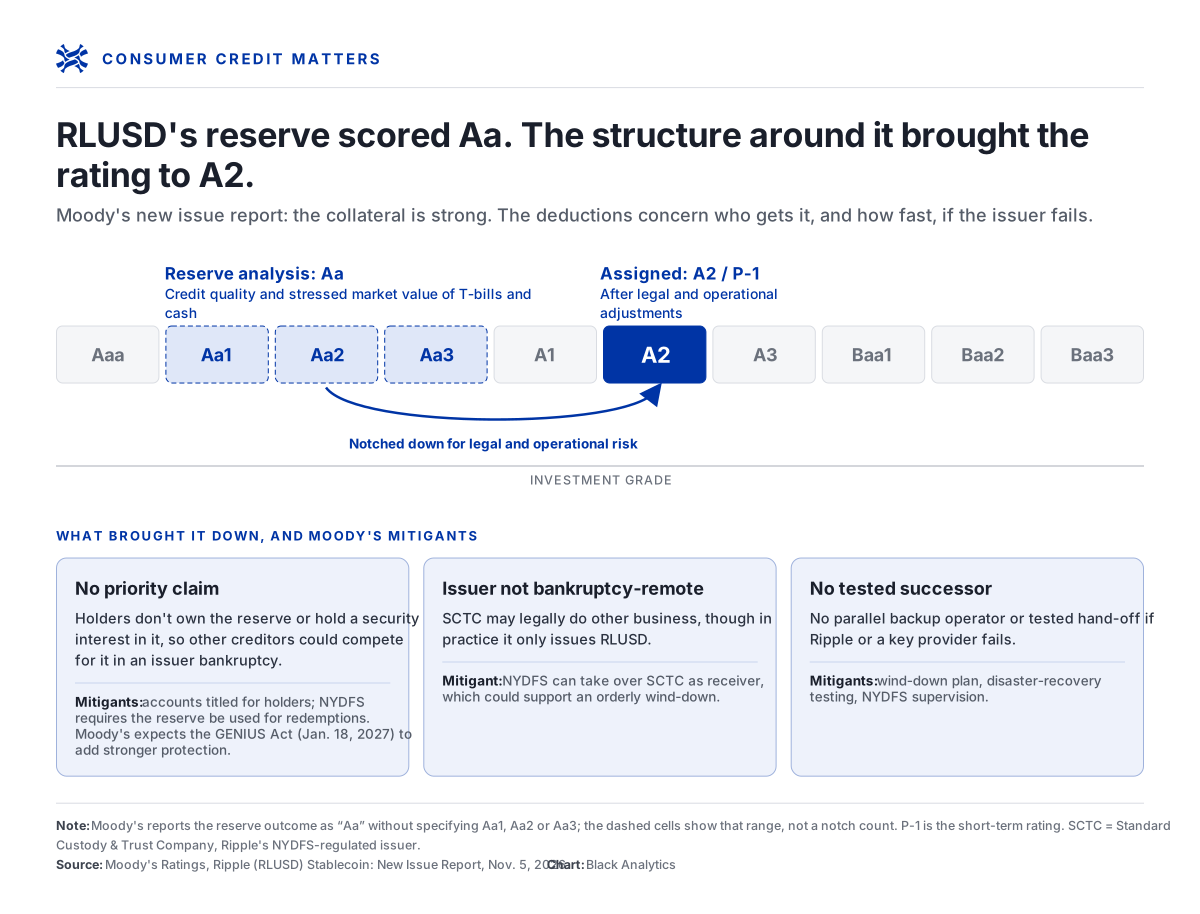
Moody's put the reserve's credit quality and stressed market value in the Aa range, then notched the rating down to A2 for legal and operational risk. It doesn't say Aa1, Aa2 or Aa3, so the notch count isn't disclosed. Three deductions stand out:
No priority claim. Holders don't own the reserve or hold a security interest in it, so other creditors could compete for it if the issuer, Ripple's New York trust company Standard Custody & Trust Company (SCTC), failed.
Not bankruptcy-remote. SCTC is legally free to do other business, though in practice it only issues RLUSD.
No tested successor. No backup operator is ready to step in if Ripple or a key provider fails.
Exhibit 2
The report also settles a question CCM raised last week: the binding requirement is 100% coverage at the end of each business day; 103% is SCTC’s target, not a commitment.
Why exactly A2
Moody's methodology treats A2/P-1 as a line. To rate at or above it, key counterparties must be rated at least A2/P-1, or strong operational backups must be in place; short of that, Moody's typically rates lower. The report says SCTC has no parallel backup, and it cites no rating for Ripple. Moody's instead credited SCTC's wind-down plan, disaster-recovery testing and supervision by New York's Department of Financial Services (NYDFS). RLUSD sits right on that line, on Moody's judgment that those safeguards are strong enough. That leaves little cushion if they weaken, or if Ripple itself comes under stress.
What the P-1 does and doesn't promise
The P-1 is aligned with the A2 and rests on a highly liquid reserve. It speaks to SCTC paying $1 within two business days, not to RLUSD's market price. Only vetted institutions can redeem directly; everyone else holds a claim on an exchange or other intermediary. And the rating covers only RLUSD issued natively on the XRP Ledger and Ethereum.
The path up runs through GENIUS
Moody's cites the GENIUS Act, expected to take effect January 18, 2027, among the reasons for the rating. In Moody's reading, the law would keep reserve assets out of an issuer's bankruptcy estate and give holders a superpriority claim. Moody's will also watch for "contemplated security-interest and collateral-trustee arrangements"; Ripple has said its new national trust bank will serve as collateral trustee for holders. The report promises no upgrade, but both changes target its main legal concern.
The Binance hack
The report, dated November 5, doesn't mention the October 29 hack, in which attackers the FBI ties to North Korea took more than $6 billion from Binance. Ripple froze some of the stolen RLUSD; Binance's CEO put it at about $200 million, though on-chain tallies run lower. The breach was of Binance's wallets, not SCTC's, and a P-1 bank would freeze stolen deposits too.
Still, the report flags related risks in general terms: some RLUSD minting keys sit in "warm," internet-connected wallets, and SCTC's controls haven't been tested by a severe stress event. As of November 7, CCM had found no public comment from Moody's on the freeze.
Worth watching
Segregation and scope. The methodology applies only where reserves are effectively segregated, including in bankruptcy, yet the report calls RLUSD's segregation imperfect. How Moody's reconciled the two isn't explained.
Freeze governance. Who decides, on what standard, and what recourse a holder has if a freeze is disputed.
CCM read: Moody’s showed its work, and it holds together: an Aa reserve, cut to A2 for structure. The rating leans on regulation, NYDFS now and GENIUS from January, to do the work that bankruptcy-remote plumbing does for securitization investors. And it sits right at the methodology’s A2 line, with little room to spare.
New Deals & Presale Reports
6 publicly registered issues this weekEach deal opens its CCM presale report. SEC publicly registered transactions only — 144A and private placements excluded. Full library: CCM Issuance table.
| Issuer / Series | Asset class | PSR | Close | Size ($MM) | WAL (yrs) | WA FICO |
|---|---|---|---|---|---|---|
| Preliminary — final prospectus not yet filed | ||||||
| VWALT 2026-CVolkswagen Auto Lease Trust 2026-CPrelim | Auto Lease | Nov 18 | 745.1 | — | 779 | |
| SYNCT 2026-3Synchrony Card Issuance Trust 2026-3Prelim | Credit Card | Nov 16 | 500.0 | — | 712 | |
| WOART 2026-DWorld Omni Auto Receivables Trust 2026-DPrelim | Auto Loan | Nov 18 | 1,000.9 | — | 758 | |
| WFCARD 2026-2WF Card Issuance Trust WFCardSeries Class A(2026-2) NotesPrelim | Credit Card | Nov 12 | 500.0 | — | 729 | |
| Priced this week | ||||||
| HAROT 2026-4Honda Auto Receivables 2026-4 Owner Trust | Auto Loan | Nov 12 | 2,105.3 | 2.39 | 772 | |
| HART 2026-DHyundai Auto Receivables Trust 2026-D | Auto Loan | Nov 10 | 1,997.2 | 2.44 | 775 | |
Loan-Level Pulse
Reproducible signals · ABS-EE surveillanceA few signals from this week's loan-level tape — each links to the exact view on CCM so you can reproduce it. Explore the full data ›
Honda
Macro
Rates · Used cars · ConsumerUnemployment rate
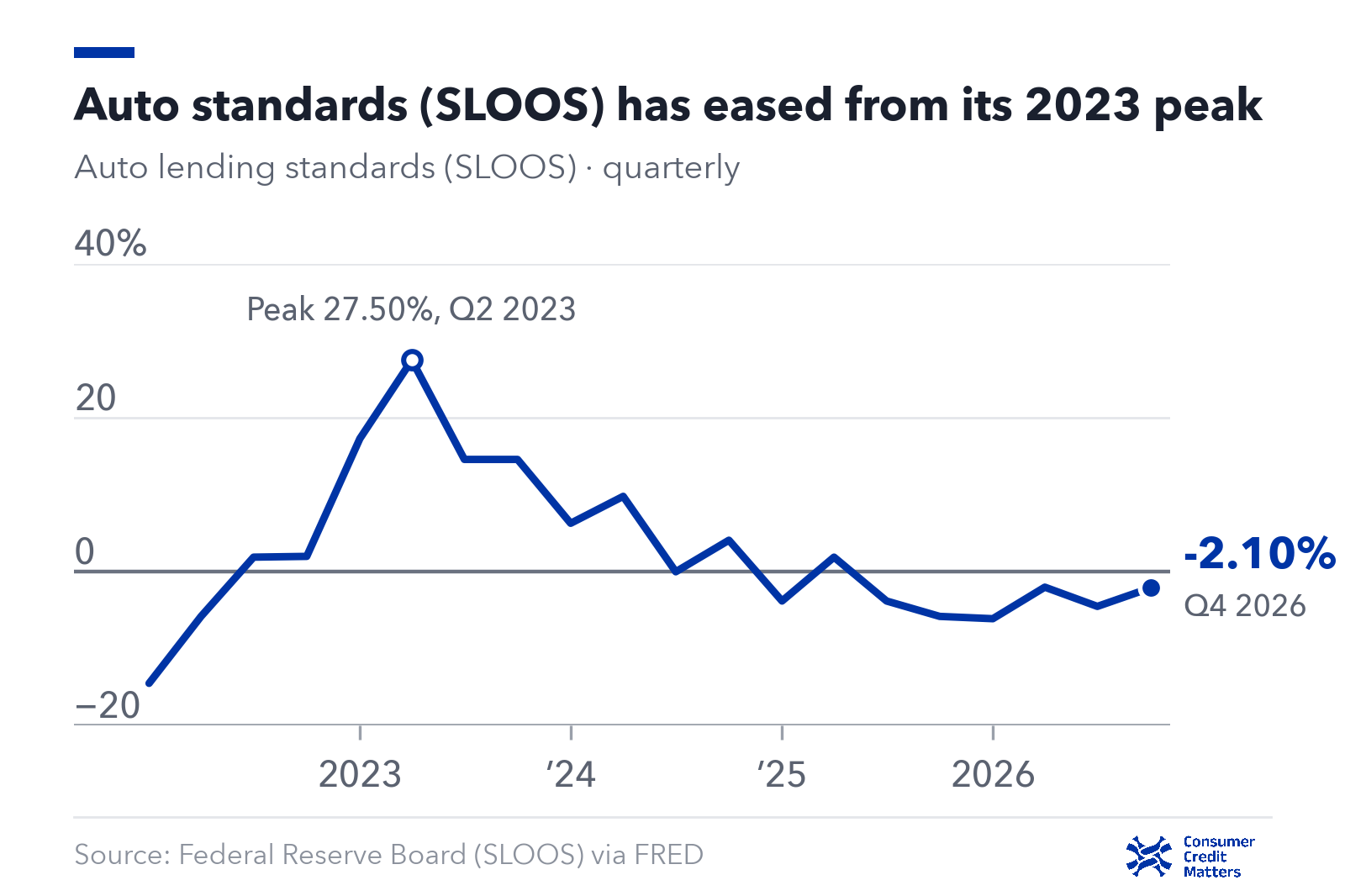
Auto standards (SLOOS)
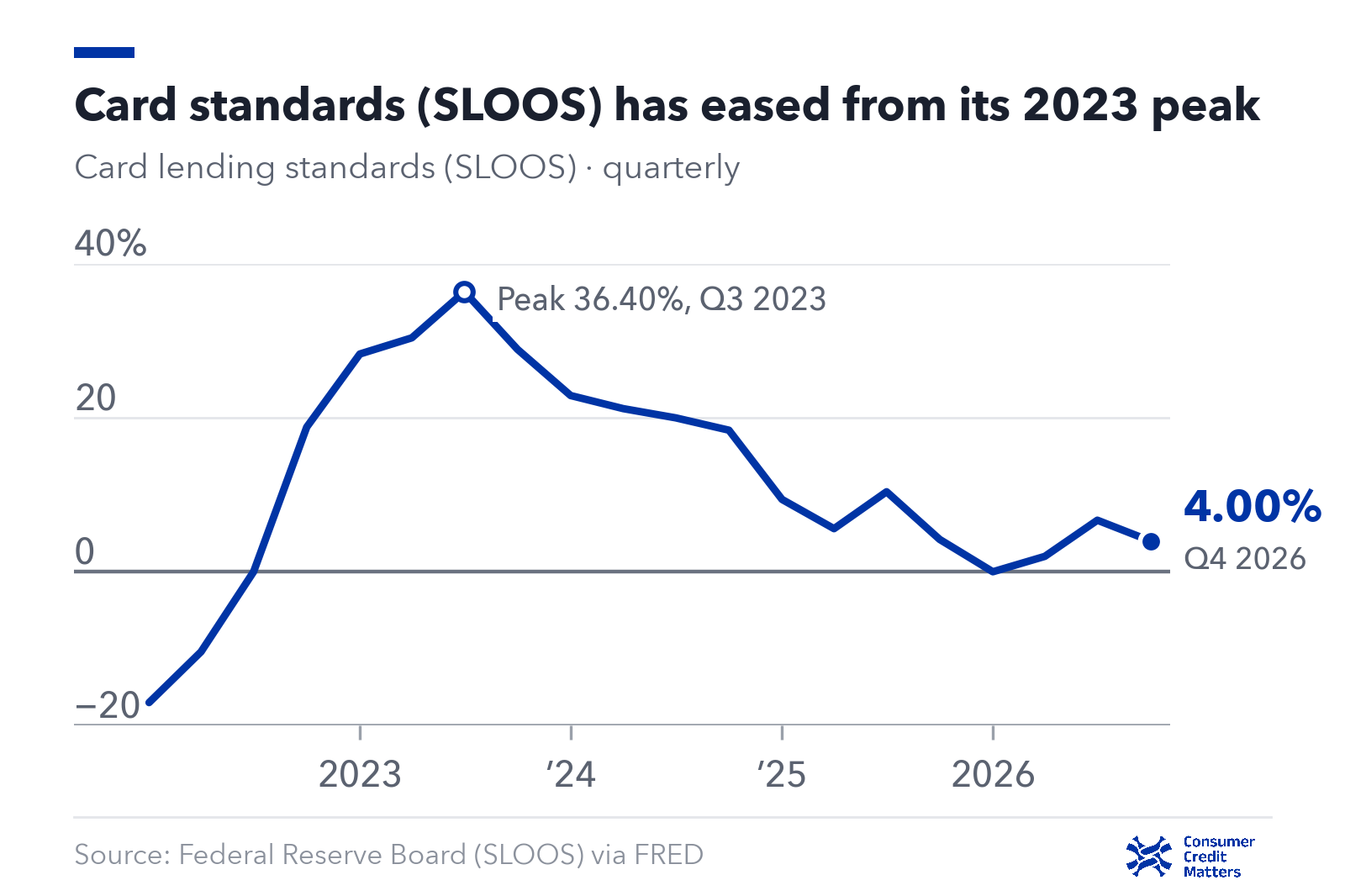
Card standards (SLOOS)
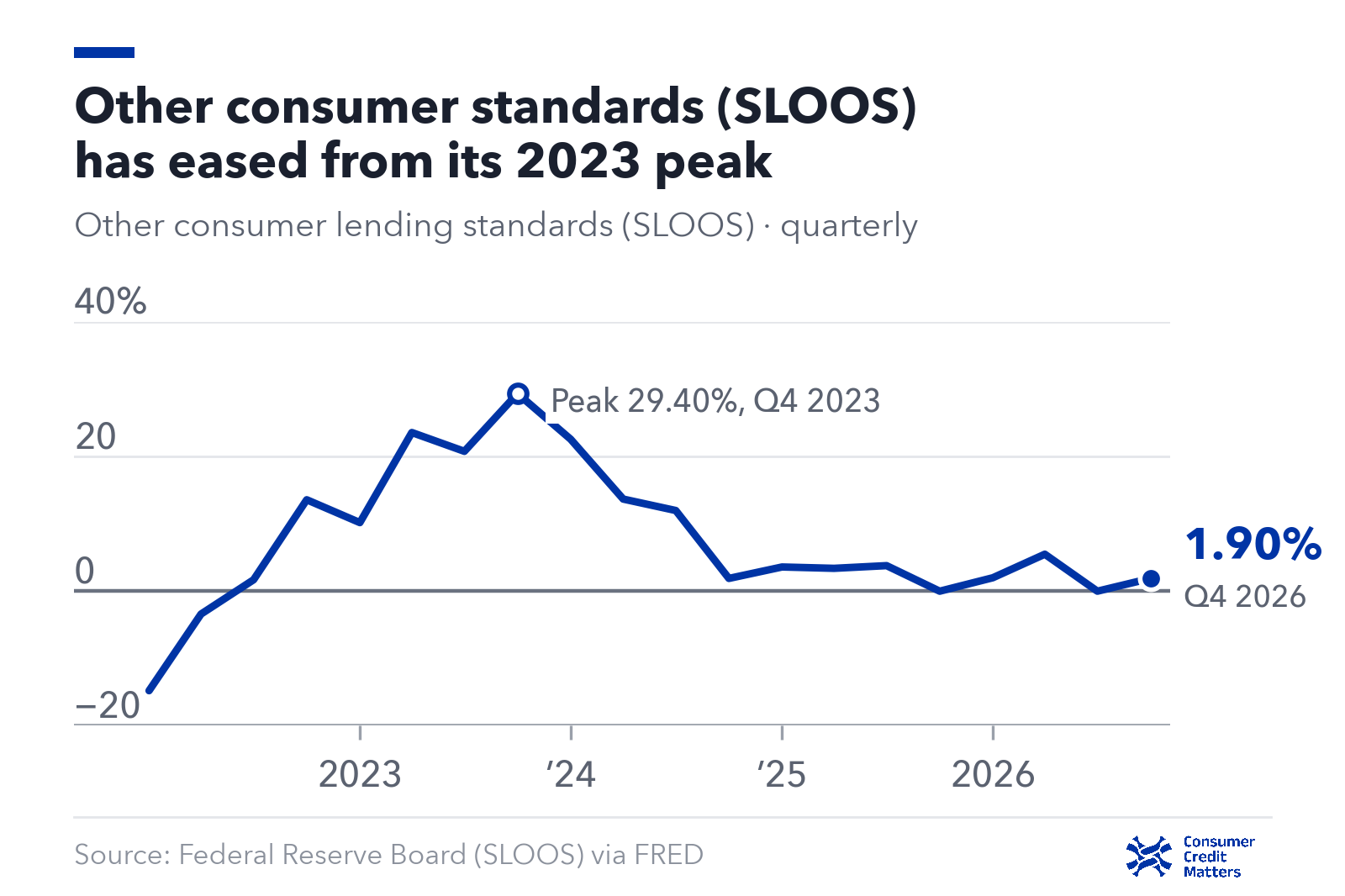
Other consumer standards (SLOOS)
From the Pod
This week's episodeConsumer ABS: Resilient, for Now, with Barclays’ Elana Lipchak
Barclays' Elana Lipchak on why US consumer credit hasn't cracked yet, where the pressure points sit, and what could shift the ABS picture by 2027.
Watch on YouTube ›On Deck
Data releases · ABS-EE filings · eventsMacro releases
- Nov 10New Car CPI
- Nov 10CPI (Not Seasonally Adjusted)
- Nov 10Core CPI
- Nov 10Headline CPI
- Nov 10Auto Repair CPI
- Nov 10Auto Parts CPI
- Nov 10Used Car CPI
- Nov 12Initial Claims
- Nov 12Continued Claims
- Nov 1230-Year Mortgage Rate
- Nov 1215-Year Mortgage Rate
- Nov 13Housing Affordability Index
- Nov 13Median Existing Home Price
- Nov 13Existing Home Months Supply
- Nov 13Existing Home Sales
- Nov 14Consumer Confidence (OECD)
ABS-EE filings expected
- Nov 16Bridgecrest Lending Auto Securitization TrustBLAST · ABS-EE 10-D · last filed Oct 15
- Nov 16CarMax Auto TrustCAOT · ABS-EE 10-D · last filed Oct 15
- Nov 16Santander Drive Auto Receivables TrustSDART · ABS-EE 10-D · last filed Oct 15
- Nov 16Carvana Auto Receivables TrustCRVNA · ABS-EE 10-D · last filed Oct 15
- Nov 16DRIVE AUTO RECEIVABLES TRUSTDRIVE · ABS-EE 10-D · last filed Oct 15
- Nov 16CarMax Select Receivables TrustCMXS · ABS-EE 10-D · last filed Oct 15